
Why Used EV Searches Have Jumped 79% in Northern Ireland
A clear shift, in real time
Used Cars NI has been part of the Northern Irish motoring scene for years. We watch how people here search, what they look for, and how that changes when life around them changes. Right now, something significant is happening.
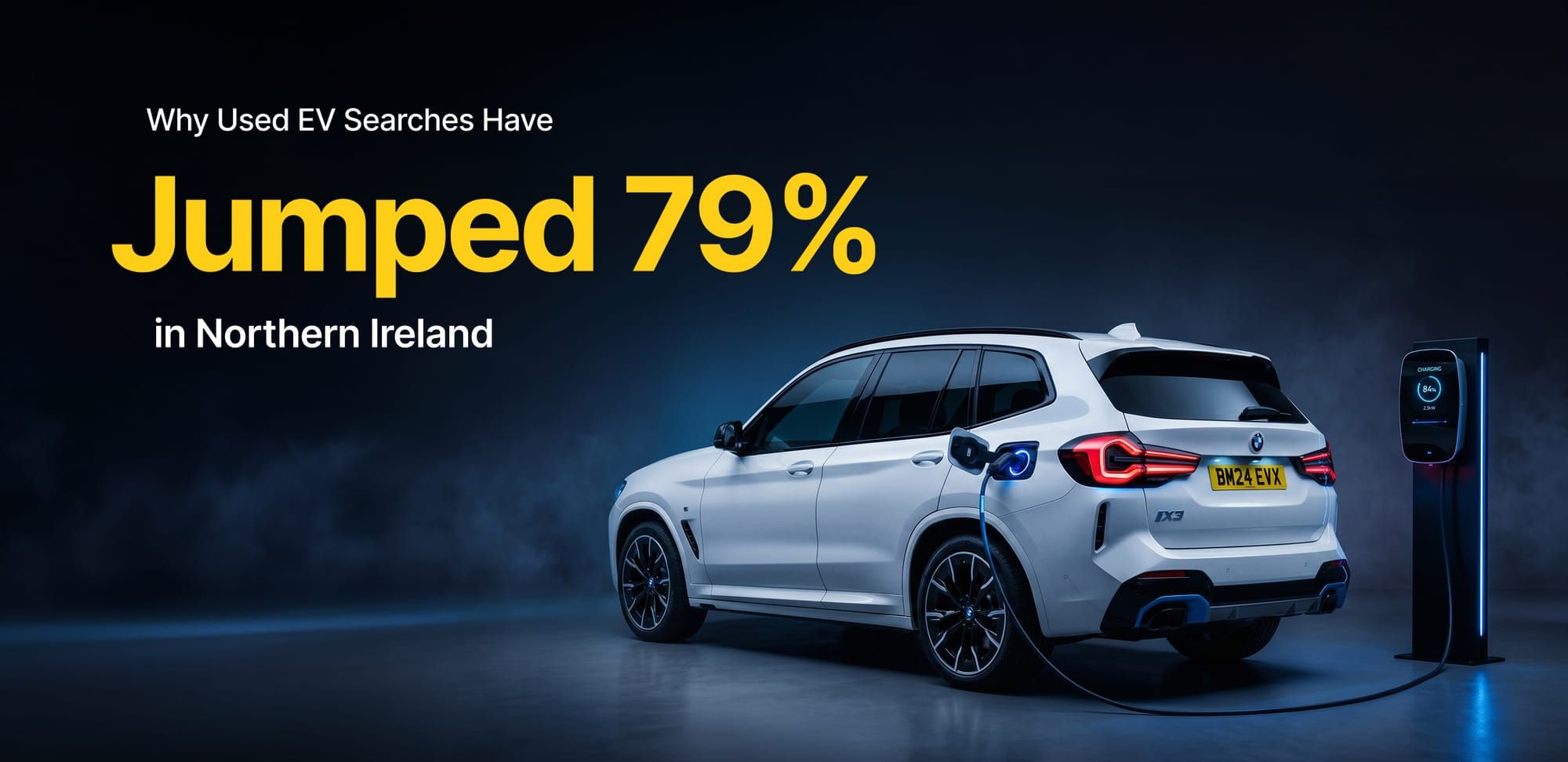
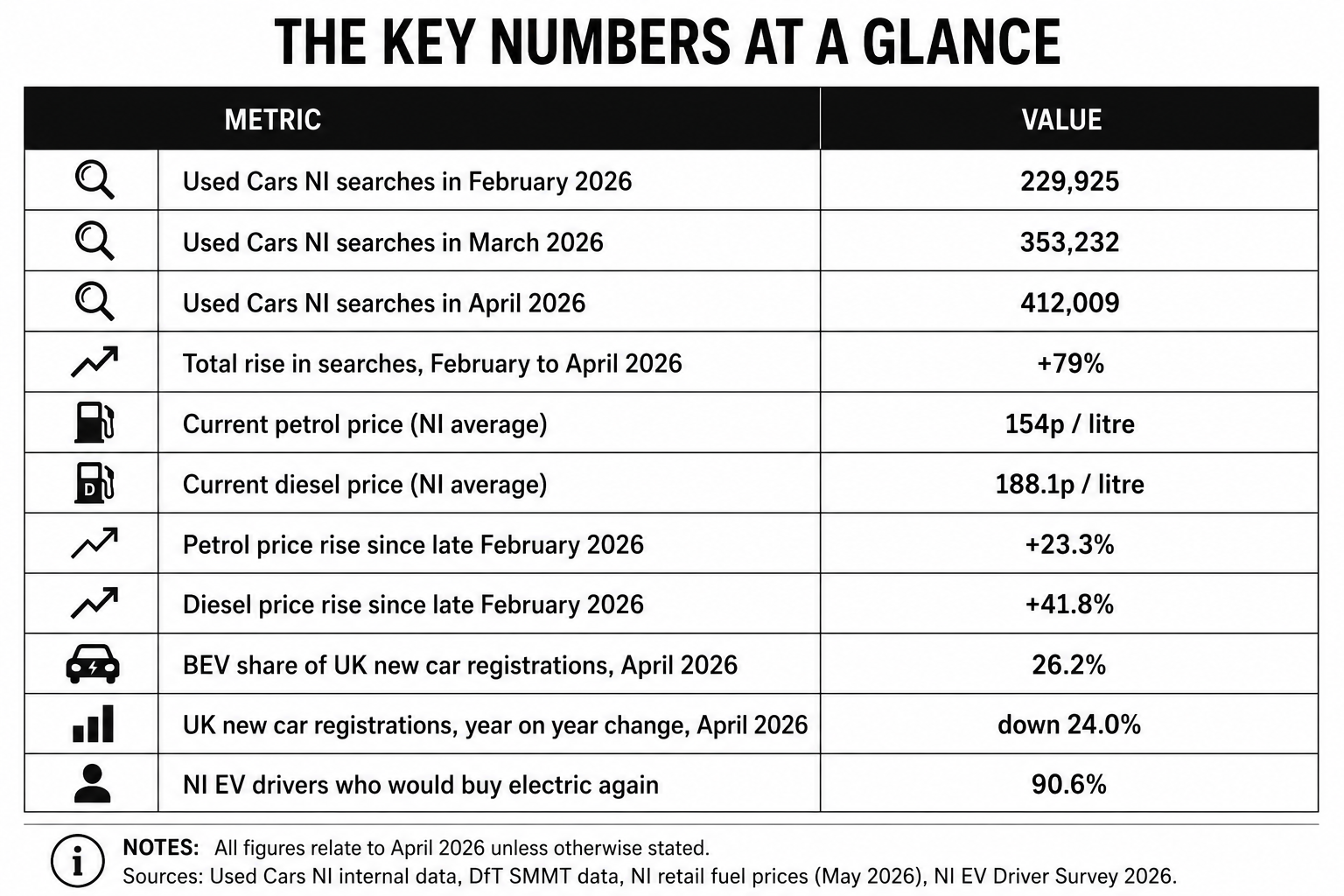
Since fuel prices began climbing at the end of February 2026, EV searches on Used Cars NI have risen by 79%. In February, the platform recorded 229,925 searches. By March, that had jumped to 353,232. By April, the figure reached 412,009. That is not a small bump. It is one of the sharpest shifts in search behaviour we have ever recorded, and it has happened in a matter of weeks.
What is driving the change
The Consumer Council Northern Ireland surveys pump prices across 28 towns and cities every week. Their most recent figures make for difficult reading. Petrol now sits at an average of 154p a litre. Diesel is at 188.1p. That is a rise of 23.3% on petrol and 41.8% on diesel since prices were last stable at the start of the year.
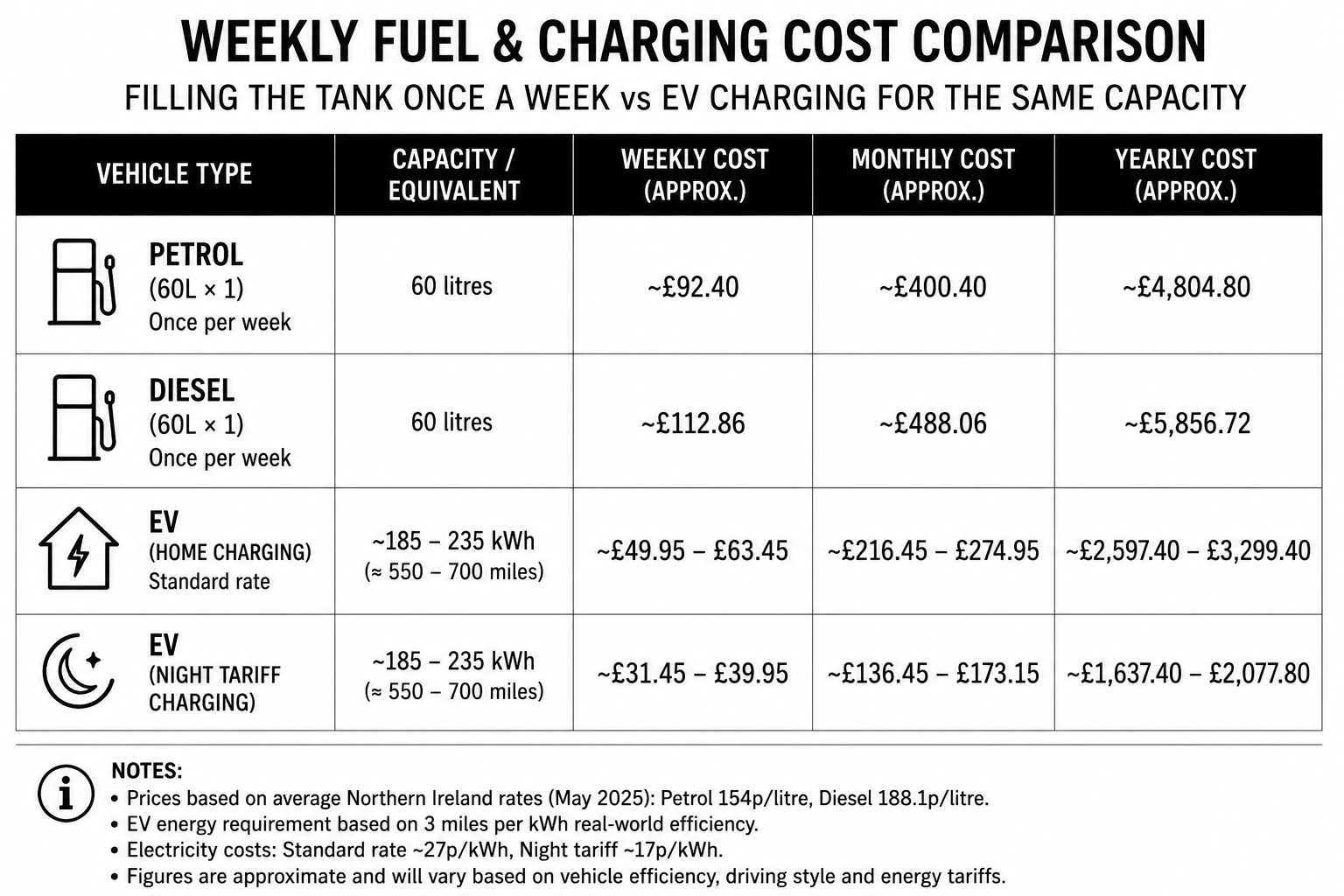
To put that in everyday terms, if you drive a diesel and fill a 60 litre tank twice a week, you are spending roughly £220 more every month than you were at the start of the year. That is money that would otherwise be going on the weekly shop, the energy bill, or the children.
Agricultural diesel, which many of our farming and rural communities depend on, is currently sitting at around £1.16 a litre. That is up by roughly 50p since January. For people running machinery or a working vehicle every day, the increases add up quickly.
Home heating oil is a pressure point that is unique to Northern Ireland. Some households are now paying around £550 for 500 litres. That is well above where prices sat for much of the previous year. Many people are managing higher fuel costs and higher heating costs at the same time.
The House of Commons Library confirms that prices were relatively stable between summer 2025 and early 2026, sitting at around 135p for petrol and 143p for diesel. The rise since then has been steep and quick.
What people are weighing up
The 53.6% rise in our search volumes between February and March suggests that the moment prices climbed, drivers started looking towards Electric options. The further 16.6% increase from March into April indicates interest has not faded. People are looking at their options carefully as daily cost of living increases.
What we are seeing on the platform is a wider range of buyers exploring fuel efficient petrol and diesel cars, hybrids, and increasingly, electric vehicles. Nationally, the picture reflects that shift. According to the Society of Motor Manufacturers and Traders, battery electric vehicles accounted for 26.2% of all new car registrations in April 2026. That is more than one in four new cars sold across the United Kingdom in a single month. In Northern Ireland the transition is happening more slowly, but the direction of travel is the same.
Could an EV be right for you?
Interest in electric vehicles is real and continues to grow. Supply and affordability access are different matters, and it is important to be honest about both.
The most affordable new EVs, including models such as the MG4 and the Hyundai Inster, start from around £22,000 to £26,000. That remains a significant outlay for many households, particularly when budgets are already under pressure from rising fuel and energy costs. The UK Government’s plug in car grant for new vehicles was scrapped for most buyers in 2022, so there is no direct purchase subsidy available to the majority of drivers in Northern Ireland today.
The wider new car market reflects similar affordability pressures. SMMT data shows that new car registrations fell 24.0% year on year in April 2026, totalling 149,247. Sue Robinson, Chief Executive of the National Franchised Dealers Association, summed up the mood in the sector:
“April’s figures are disappointing and underline the continued fragility of the new car market. Demand remains under pressure as consumers face affordability challenges and ongoing uncertainty. While electrified vehicle uptake continues, the current pace of transition remains challenging for the sector. Greater support is needed to boost consumer confidence and ensure the market can deliver sustainable growth in the months ahead.”
Sue Robinson, Chief Executive, National Franchised Dealers Association
For many buyers in Northern Ireland, that wider pressure is precisely why the growing used EV market matters so much. It offers the running cost benefits of electric driving without new car prices.
The used EV market is expanding and prices are coming down. That is opening up real options for more buyers. Awareness of what is now available in the used space is still catching up with the supply.
The realities of home charging
Electric vehicle ownership can work well for drivers who can charge at home. For drivers who cannot, the picture is different.
For those who plug in overnight at home on a night rate tariff, annual charging costs can fall to under £200. That is a meaningful saving when set against the cost of running a petrol or diesel today. Home charging is, in practice, the foundation of affordable EV ownership.
Home charging requires off street parking, a driveway, or somewhere safe and accessible to install a charger. For people living in terraced streets across any of the towns and villages of the Province, that space is often not available. Drivers in flats and rented homes can find themselves with no practical home charging option, which leaves them more reliant on more expensive public charge points.
Public charging in Northern Ireland
According to government statistics from April 2025, Northern Ireland sits at the bottom of the UK table for rapid and ultra rapid charging, with just 9.9 devices of 50kW or above per 100,000 people. Every other region in the UK is ahead of us.
For drivers in rural communities, on the Antrim coast, in Fermanagh, and across the border counties, the gap between charge points is a real practical concern.
The picture is, however, moving in the right direction. Northern Ireland saw approximately 29% growth in rapid charger numbers during 2025. The day to day experience of EV drivers here has improved markedly. The EVANI 2025 survey found that, in 2022, 67.8% of NI EV drivers regularly had to wait for a public charger. By 2025, that figure had fallen to 4.9%. A further 63.4% said charging was easier than the year before.
Regulatory changes expected in spring 2026 are expected to reduce the cost for operators of installing higher powered chargers across the Province. That should help to maintain the pace of progress.
The conversation around EVs
There is one further factor that came directly from drivers who already own and use EVs in Northern Ireland.
The EVANI 2025 survey asked existing NI EV drivers what they felt was holding back wider uptake. Misinformation came up repeatedly. In their own words, drivers cited “bad press and fear mongering on social media”, “disinformation”, “false information in the media”, and “negative propaganda”.
These are not assumptions. These are everyday Northern Irish drivers who have made the switch, and who watch friends and family hesitate over concerns that do not match their lived experience. When 90.6% of NI EV owners say they would buy electric again, but a meaningful share of non owners still believe EVs are more expensive to run, something is being lost in translation.
The road forward
The picture is challenging in places, but the direction of travel is steady. There are four areas where progress would make the most practical difference for drivers in Northern Ireland.
Expanding the public charging network
The most immediate priority is more rapid chargers along the main routes outside Belfast, and in the towns and villages that rural Northern Ireland depends on. The Department for Infrastructure has flagged this as a priority. The 2026 regulatory changes should help to bring down installation costs for operators. An all island approach to charging infrastructure also makes sound sense given how regularly people travel north and south.
Strengthening the used EV market
For most Northern Ireland households, a used electric vehicle is the realistic first step rather than a brand new one. Over 61% of NI EV drivers picked up their current car within the last two years. Half bought their first EV within the last three years. The used market is maturing quickly.
Helping buyers understand what to look for, how to check battery health, and what real running costs look like would open the door to a great many more families. This is exactly the kind of practical, locally rooted guidance that we are well placed to support, in close partnership with the dealers we work with across the Province.
Charging for households without a driveway
For people living in rented homes, in flats, and on terraced streets, on street charging needs to improve. Lamp post chargers, community hubs in car parks and sports clubs, and neighbourhood charging schemes have been tried successfully elsewhere in the UK. Northern Ireland has a clear opportunity to learn from those examples and adapt them to local conditions.
Honest, local information
The facts speak for themselves. The vast majority of EV owners report lower running costs, while a meaningful share of non owners still believe the opposite. That gap closes with good information. People in Northern Ireland deserve straightforward, locally relevant guidance that reflects how they actually live, travel, and get around.
What this means for you
Fuel prices in Northern Ireland are at their highest in several years. That is putting genuine pressure on real people. Whether you are doing the school run in Ballymena, running a van out of Newry, or working a farm outside Enniskillen, the cost of keeping a vehicle on the road is now higher than it has ever been.
For some people electric vehicles offer a credible way to lower running costs over time. The drivers who have already made the switch in Northern Ireland are, in the main, very pleased they did. Nine in ten say they would buy electric again. Home charging costs can fall below £200 a year. The day to day charging experience continues to improve.
Across the UK, more than one in four new cars sold in April 2026 were fully electric. Northern Ireland sits behind that curve, but the gap is closing, and the financial case for considering a switch has rarely been stronger.
EVs are not always the right answer for every household. If you do not have somewhere to charge at home, if the upfront cost is too much of a stretch, or if you live somewhere the public network still has gaps, those are real considerations.
The used EV market is where the practical opportunity sits for many people. Prices are coming down. Choice is improving. The savings on running costs are now substantial when set against today’s fuel prices.
Whatever you are thinking about doing next with your vehicle, our role is to help you weigh up what makes sense for your circumstances, with honest information and a wide choice of trusted local sellers.
Sources
Used Cars NI: Platform Search Data, February to April 2026.
Consumer Council Northern Ireland: Weekly Fuel Price Surveys. consumercouncil.org.uk/energy/oil-and-gas/oil-prices
SMMT: New Car Registration Data, April 2026. smmt.co.uk/vehicle-data/car-registrations
National Franchised Dealers Association: April 2026 Market Commentary. nfda-uk.co.uk
Belfast Newsletter: NI Pump Price Breakdown (154p and 188.1p figures). newsletter.co.uk/business/rise-in-fuel-prices-shows-signs-of-slowing-down-as-home-heating-oil-drops-across-northern-ireland-6577920
House of Commons Library: Petrol and Diesel Prices Research Briefing, April 2026. commonslibrary.parliament.uk/research-briefings/sn04712
EVANI: Northern Ireland EV Drivers Survey 2025. evani.uk/northern-ireland-ev-drivers-survey-2025-results
Zapmap: EV Charging Statistics 2025 Report. zapmap.com/ev-charging-statistics-2025-report
Steer Group: Accelerating EV Adoption in NI and ROI. steergroup.com/projects/accelerating-ev-adoption-ni-roi
EV Charge Points in Northern Ireland and Wales. evisionevs.co.uk/2025/09/09/electric-vehicle-charge-points-in-northern-ireland-and-wales/
Department for Infrastructure NI: EV Infrastructure Action Plan. infrastructure-ni.gov.uk/publications/electric-vehicle-infrastructure-action-plan
EVANI: Northern Ireland Public Charging Network Developments. evani.uk/northern-irelands-public-ev-charging-projects-a-summary
A note on the figures
Search volume figures are based on Used Cars NI internal platform data for February, March, and April 2026. They represent total monthly searches across the platform.
Fuel price figures are based on Consumer Council Northern Ireland weekly survey data and House of Commons Library research, accurate at the time of publication. Fuel prices change regularly and vary between forecourts across the Province. Always check your local pumps before you travel.
SMMT new car registration figures are UK wide and do not reflect Northern Ireland specific data. Northern Ireland EV adoption rates remain considerably lower than the UK national average.
Electric vehicle running cost figures are estimates based on average annual mileage and typical home and night rate electricity tariffs in Northern Ireland at the time of publication. Your actual costs will depend on the vehicle you choose, how you drive, your electricity supplier and tariff, and whether you charge at home or use public charge points.
Survey statistics are sourced from third party research, including the EVANI Northern Ireland EV Drivers Survey 2025. Used Cars NI has not independently verified the methodology or sample sizes of third party surveys.
This article is for general information only. It is not financial, legal, or purchasing advice. Used Cars NI is not a financial adviser. Before making any vehicle purchase decision, please carry out your own research based on your own circumstances. Vehicle availability and pricing are subject to change. Used Cars NI accepts no liability for decisions made on the basis of the information in this article.